
Inverex GO FireBird sits toward the expensive end of Pakistan’s electric motorcycle market. With a starting price of Rs. 485,000, this isn’t really aimed at someone looking for the cheapest way to replace a petrol bike. The FireBird has a 3,000W motor, a relatively large lithium battery and, in the Pro version, a second battery that pushes the claimed range much higher.
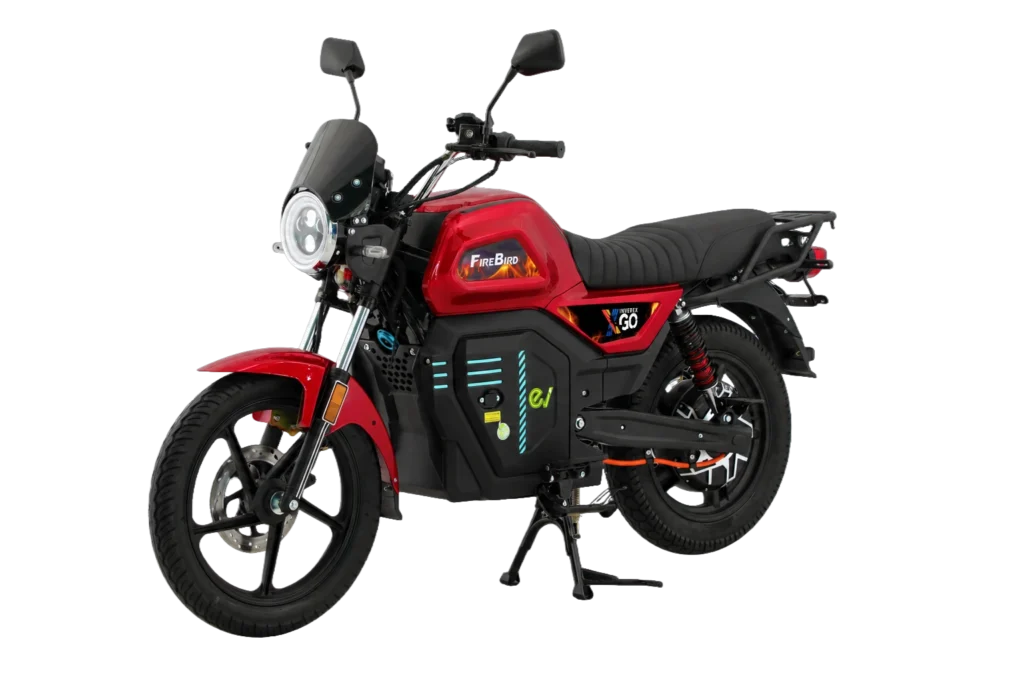
That makes the choice between the two versions more important than it might initially seem. The Lite is the simpler proposition. The Pro is built around having more battery capacity and more available power.
| Specification | FireBird Lite | FireBird Pro |
|---|---|---|
| Motor | 3,000W | 3,000W |
| Peak Power | — | 6,000W |
| Battery | 72V 32Ah | 2 × 72V 32Ah |
| Battery Type | Semi-solid lithium | Semi-solid lithium |
| Claimed Range | Up to 100 km | Up to 200 km |
| Fast Charging | — | Around 2 hours |
| Starting Price | Rs. 485,000 | — |
The 3,000W motor is probably the first specification that will catch the attention of anyone used to the smaller electric bikes currently available in Pakistan. But motor wattage alone doesn’t tell you how the FireBird will feel on the road. Controller settings, battery output, weight and gearing all have a role in how an electric motorcycle actually performs.
The Pro gets an interesting upgrade. Its rated motor output remains 3,000W, but Inverex quotes peak power of 6,000W. That extra headroom should be more useful when accelerating or carrying a passenger than it would be when simply cruising through city traffic.
Then there’s the battery.
The Lite uses one 72V 32Ah semi-solid lithium battery. On a simple calculation, that’s around 2.3 kWh of nominal battery capacity. The Pro effectively doubles that by using two batteries of the same voltage and capacity. That’s why Inverex’s claimed range jumps from 100 km to as much as 200 km.
I wouldn’t take either range figure as a guaranteed distance. Electric-bike range depends heavily on how the motorcycle is ridden. A rider travelling at moderate speeds through relatively light traffic will get a different result from someone constantly accelerating, riding at higher speeds or carrying a passenger. Temperature and road conditions matter too.
Still, the battery difference is significant. If you have a short daily commute, the Lite’s battery may be perfectly adequate. Buying the Pro purely because it has a 200 km claimed range could mean spending more money on capacity you rarely use.
For a rider covering longer distances, however, the Pro becomes easier to justify. Having twice the battery capacity means fewer charging stops and more flexibility if the bike is being used throughout the day. Inverex also says the Pro supports fast charging in around two hours, although actual charging time can vary depending on charging conditions and battery temperature.
There’s another question I’d ask before spending nearly half a million rupees on any electric motorcycle: what happens after the battery gets old?
That’s something buyers should think about before looking only at the range figure. Lithium batteries don’t suddenly become useless after a fixed number of kilometres, but their capacity gradually declines. A replacement battery can also be one of the most expensive components of an electric motorcycle. Inverex’s warranty terms, replacement-battery pricing and local availability are therefore just as important to ownership as the original specification.
The FireBird’s Rs. 485,000 starting price also changes how I would compare it with conventional motorcycles. Someone buying a petrol 70cc or 100cc for basic commuting is solving a different problem. The FireBird costs considerably more upfront, so the argument for buying it has to come from its lower running costs, electric drivetrain and the convenience of charging at home.
That calculation will vary from one rider to another. Someone travelling 10 or 15 kilometres a day may take a long time to recover the additional purchase price through fuel savings. A rider covering much greater distances every day has more potential to benefit from lower energy costs.
The Pro is harder to judge without a real-world test. A claimed 200 km range sounds impressive, but I’d want to see how close owners get to that figure in normal Pakistani traffic before treating it as a major reason to buy the bike. The same goes for the claimed two-hour fast charging time.
For me, the FireBird Lite makes more sense for an ordinary city commuter, assuming the 100 km claimed range is sufficient for the rider’s routine. The Pro is the more interesting machine, but its extra battery capacity only makes sense if you’re actually going to use it.
That distinction is easy to overlook when comparing electric bikes. Bigger battery, higher power and longer range look better on a specification sheet. They don’t automatically make a bike better value.
The FireBird is an ambitious offering from Inverex, especially at this price. Its strongest argument isn’t that it has a bigger number beside every specification. It’s that the Pro gives high-mileage riders considerably more battery capacity, while the Lite keeps the basic package somewhat simpler.
Before buying either one, I’d want to check three things directly with the dealer: the exact warranty on the battery, the current price of a replacement battery, and where the motorcycle can be serviced. Those answers could have a much bigger impact on the long-term cost of owning a FireBird than the difference between 100 and 200 km on the brochure.